
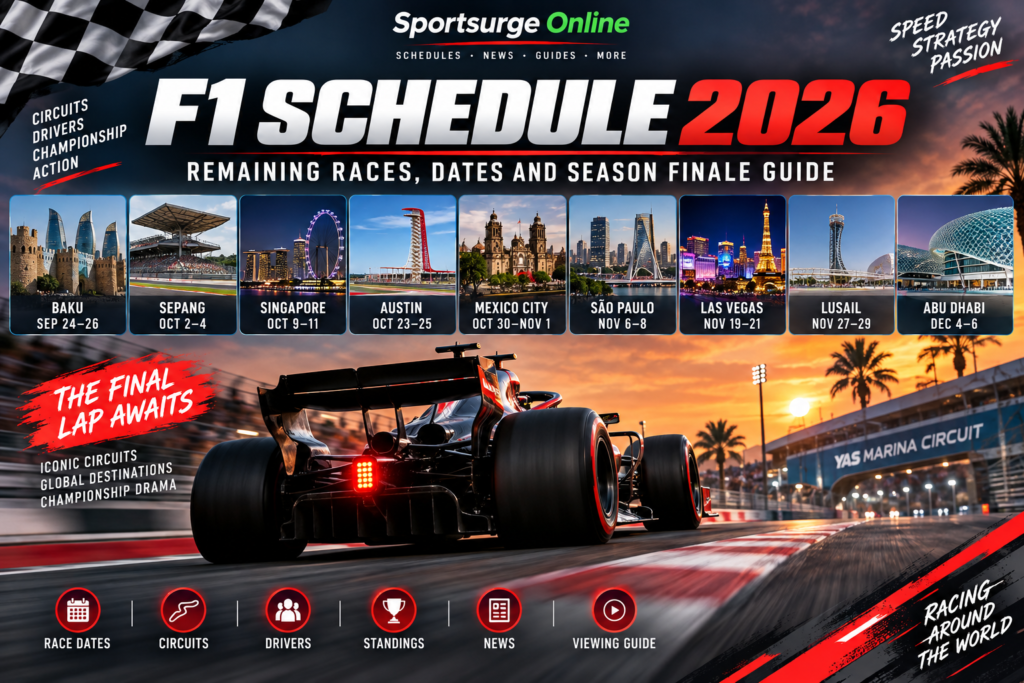
The 2026 Formula 1 season has entered its final stretch, but there is still plenty of racing ahead.
Following the September round in Madrid, Formula 1 moves to Baku for the Azerbaijan Grand Prix before continuing through Asia, the Americas and the Middle East.
The closing part of the season includes some of the most distinctive circuits on the calendar, from the narrow streets of Baku and Singapore to high-speed races in Austin, Las Vegas and Lusail.
The championship is scheduled to conclude at Yas Marina Circuit in Abu Dhabi in December.
There has also been an important calendar development during the season. The originally scheduled Bahrain Grand Prix at Sakhir did not take place in April, and Formula 1 later announced plans for the Bahrain Grand Prix to be staged at Malaysia’s Sepang International Circuit from October 2–4.
Here is the remaining 2026 Formula 1 schedule and what fans should know about the final part of the season.
Remaining F1 Schedule for 2026
| Dates | Grand Prix | Location |
|---|---|---|
| September 24–26 | Azerbaijan Grand Prix | Baku, Azerbaijan |
| October 2–4 | Bahrain Grand Prix in Malaysia* | Sepang, Malaysia |
| October 9–11 | Singapore Grand Prix | Singapore |
| October 23–25 | United States Grand Prix | Austin, USA |
| October 30–November 1 | Mexico City Grand Prix | Mexico City, Mexico |
| November 6–8 | São Paulo Grand Prix | São Paulo, Brazil |
| November 19–21 | Las Vegas Grand Prix | Las Vegas, USA |
| November 27–29 | Qatar Grand Prix | Lusail, Qatar |
| December 4–6 | Abu Dhabi Grand Prix | Abu Dhabi, UAE |
*Formula 1 announced the Sepang event as the Bahrain Grand Prix in Malaysia, subject to the required final agreements and official approval.
Race schedules can change, so fans should check the latest official Formula 1 or FIA timetable before making travel or viewing plans.
What Happened to the Original 2026 F1 Calendar?
The calendar fans saw before the season is not identical to the schedule being followed later in 2026.
The original calendar included Bahrain at Sakhir from April 10–12 and Saudi Arabia at Jeddah from April 17–19.
Those rounds were subsequently removed from the amended FIA calendar.
Formula 1 then announced in July that Malaysia’s Sepang International Circuit was planned to host the Bahrain Grand Prix from October 2–4.
The arrangement places the event between Azerbaijan and Singapore.
That is why anyone checking the 2026 schedule should pay attention to current calendar updates rather than relying entirely on an older preseason schedule.
Azerbaijan Grand Prix
The next scheduled Formula 1 round is the Azerbaijan Grand Prix in Baku.
The event runs from September 24–26 at the Baku City Circuit.
Baku is one of the most unusual street circuits in Formula 1.
Parts of the track are extremely narrow, while other sections allow cars to reach very high speeds.
That combination can make setup difficult.
Teams need enough downforce for slower corners while also trying to reduce drag for Baku’s long flat-out sections.
2026 Azerbaijan Grand Prix Schedule
The current local Formula 1 timetable is:
Thursday, September 24
Practice 1: 12:30 PM local time
Practice 2: 4:00 PM local time
Friday, September 25
Practice 3: 12:30 PM local time
Qualifying: 4:00 PM local time
Saturday, September 26
Race: 3:00 PM local time
The Grand Prix is scheduled for 51 laps of the 6.003-kilometre Baku City Circuit.
Baku is four hours ahead of UTC.
Fans watching internationally should convert the local start time carefully because the session may appear at a substantially different time in their country.
Why Is the Azerbaijan Grand Prix on Saturday?
Fans accustomed to Sunday Formula 1 races may notice something unusual about the 2026 Azerbaijan schedule.
The race is scheduled for Saturday, September 26.
That also moves the practice and qualifying schedule earlier in the week.
It is therefore particularly important not to assume that every Formula 1 Grand Prix follows the standard Friday-to-Sunday structure.
Always check the official timetable for the specific race weekend.
Bahrain Grand Prix in Malaysia
One of the most unusual developments of the 2026 season involves Malaysia.
Formula 1 announced that the Sepang International Circuit would host the Bahrain Grand Prix from October 2–4.
The event was arranged as a way of preserving a Grand Prix that otherwise would not have taken place.
This does not mean Sepang has simply become a normal Malaysian Grand Prix under the original calendar.
The announced event is the Formula 1 Gulf Air Bahrain Grand Prix staged in Malaysia.
That distinction is worth understanding when reading schedules or searching for the race online.
Formula 1 Returns to Sepang
Sepang is not a new Formula 1 circuit.
The Malaysian venue first appeared on the F1 calendar in 1999 and became known for a combination of long straights, demanding corners, heat and unpredictable tropical weather.
Its return gives the 2026 calendar another established racing venue.
Weather could become an important part of the weekend.
Malaysia’s conditions can change quickly, and heavy rain has affected Formula 1 races at Sepang in the past.
Fans should therefore follow current forecasts and official session updates as the weekend approaches.
Singapore Grand Prix
After Sepang, Formula 1 is scheduled to travel to Singapore for the October 9–11 race weekend.
The Singapore Grand Prix takes place on the Marina Bay Street Circuit.
It is one of Formula 1’s most recognizable night races.
Artificial lighting, high humidity, close barriers and a demanding street layout combine to create a very different challenge from a conventional permanent circuit.
The Singapore weekend is also especially significant in 2026 because it is scheduled as a Sprint event.
What Is an F1 Sprint Weekend?
A Sprint weekend includes an additional short race.
That changes the normal Grand Prix structure.
Instead of three standard practice sessions before qualifying and the Grand Prix, Sprint weekends provide less practice and more competitive running.
The exact session format should always be checked on the official timetable.
For teams, reduced practice can make setup decisions more difficult.
For fans, it means there is meaningful competitive action on more than one day of the weekend.
United States Grand Prix
Formula 1 then crosses to the Americas.
The United States Grand Prix is scheduled for October 23–25 at Circuit of The Americas in Austin, Texas.
COTA has been a major part of Formula 1’s U.S. presence.
The circuit combines several different types of corners.
Its steep climb into Turn 1 is one of its most recognizable features.
The track also contains fast direction changes, slower technical sections and overtaking opportunities.
That variety can make car setup particularly important.
Mexico City Grand Prix
The Mexico City Grand Prix follows from October 30 through November 1.
The race takes place at the Autódromo Hermanos Rodríguez.
Altitude is one of the defining characteristics of the event.
Mexico City’s elevation affects the way Formula 1 cars behave.
The thinner air can influence aerodynamics, cooling and power-unit operation.
Teams therefore have to consider conditions that differ substantially from many other circuits on the calendar.
The stadium section near the end of the lap also gives the venue a distinctive atmosphere.
São Paulo Grand Prix
Formula 1 travels next to Brazil for the São Paulo Grand Prix from November 6–8.
The race is held at Interlagos.
Despite being relatively short in lap distance, Interlagos has produced many memorable Formula 1 races.
Elevation changes, variable weather and overtaking opportunities can all influence the weekend.
Its position late in the season can also increase its importance when championships remain undecided.
Why Brazil Can Be Unpredictable
Weather is one reason São Paulo can become difficult to predict.
Conditions can change quickly.
A dry race can become wet, while different parts of the circuit may experience different grip levels during changing conditions.
Safety cars and strategy decisions can also alter the order.
For readers following a preview, this is why race analysis should distinguish between likely strategic considerations and guaranteed outcomes.
No preview can reliably predict exactly how a Grand Prix will unfold.
Las Vegas Grand Prix
Formula 1 returns to the United States for the Las Vegas Grand Prix from November 19–21.
Las Vegas provides another street-circuit challenge, but it is very different from Singapore or Baku.
The circuit includes long high-speed sections and runs through one of the most recognizable entertainment districts in the world.
The race is held at night.
Cooler evening conditions can affect tyre warm-up and grip.
Because the event takes place late in the season, championship implications may also become increasingly important by the time Formula 1 reaches Nevada.
Why Las Vegas Dates Can Look Confusing
International fans should pay close attention to time zones when following the Las Vegas Grand Prix.
Night sessions in Nevada can occur on a different calendar date for viewers in Europe or Asia.
For example, an evening session in Las Vegas may already be taking place the following day in India or other parts of Asia.
This is why Sportsurge Online recommends checking both the official local session time and the converted time for your location.
Qatar Grand Prix
The Qatar Grand Prix is scheduled for November 27–29 at Lusail International Circuit.
Lusail features a flowing layout with many medium- and high-speed corners.
The race takes place under lights.
Tyre performance, track conditions and heat can all become important considerations during the weekend.
By this stage of the year, the championship may also be approaching its decisive point.
However, championship outcomes should never be assumed before the necessary points have actually been secured.
Abu Dhabi Grand Prix
The 2026 Formula 1 season is scheduled to conclude with the Abu Dhabi Grand Prix from December 4–6.
The race takes place at Yas Marina Circuit.
Abu Dhabi has regularly served as Formula 1’s season finale.
Its twilight schedule creates a distinctive transition from daylight into artificial lighting during the race.
When championships remain undecided, the final round can become particularly important.
Even when a championship has already been secured, teams and drivers may still be competing for final positions in their respective standings.
When Does the 2026 F1 Season End?
The final race is scheduled for Sunday, December 6, at Yas Marina Circuit in Abu Dhabi.
That means the championship continues for almost three months after the September race in Madrid.
The closing run takes Formula 1 through several regions:
Asia
North America
South America
The Middle East
The geographical changes also mean teams face significant travel and logistical demands during the final portion of the season.
Why the Final Races Matter
Late-season Formula 1 is not only about the Drivers’ Championship.
Several battles can remain important.
Drivers’ Championship
Drivers continue accumulating points toward the individual world championship.
Constructors’ Championship
Teams score points through both drivers.
The final Constructors’ standings have sporting and financial importance.
Midfield Positions
Teams outside the championship lead can still be separated by relatively small points totals.
One strong race may therefore affect championship positions.
Driver Momentum
Drivers may also be trying to finish the season strongly before attention turns toward the following year.
How Formula 1 Points Work
For a standard Grand Prix, points are awarded to the top 10 classified finishers.
The winner receives the largest points allocation, with progressively fewer points awarded down the order.
Sprint events have their own points allocation.
The championship standings are based on points accumulated throughout the season.
This means a driver’s championship position cannot be judged from race wins alone.
Consistency matters.
A driver regularly finishing near the front may remain competitive even if another driver has more individual victories.
The 2026 Formula 1 Regulation Era
The 2026 season represents a major technical change for Formula 1.
New chassis and power-unit regulations were introduced for the season.
The cars were designed around revised dimensions and aerodynamic concepts, while the power units placed greater emphasis on electrical power.
Formula 1 also moved into the new era using advanced sustainable fuel.
These changes made 2026 substantially different from the technical regulations used in previous seasons.
For fans reading older comparisons, it is therefore useful to remember that performance characteristics from previous-generation cars do not always transfer directly to the 2026 machinery.
New Manufacturers and Teams in the 2026 Era
The 2026 regulations also attracted major changes to the Formula 1 grid and manufacturer landscape.
Audi entered Formula 1 as a works operation.
Cadillac joined the championship as an additional team.
Ford also became involved through its partnership with Red Bull Powertrains.
These developments form part of the wider significance of the 2026 season.
The year is not simply another calendar of races; it marks the beginning of a substantially different technical and competitive era.
How an F1 Race Weekend Usually Works
A conventional Formula 1 weekend normally includes practice sessions, qualifying and the Grand Prix.
Practice allows teams to evaluate setup, tyres and track conditions.
Qualifying determines the starting order for the race.
The Grand Prix then awards the main championship points.
However, schedules can differ.
Sprint weekends follow a different structure, and unusual event circumstances can also alter the timetable.
The Azerbaijan weekend in 2026 is a good example because the Grand Prix is scheduled for Saturday rather than the usual Sunday.
Always check the specific race timetable rather than assuming the same format applies every weekend.
Why F1 Start Times Change Between Races
Formula 1 is a global championship.
Events take place across multiple continents and time zones.
Local race times are selected according to several factors, including daylight, climate, event format and broadcast considerations.
Some races take place during the afternoon.
Others start in the evening under lights.
Abu Dhabi begins in daylight and transitions toward night conditions.
As a result, there is no single universal Formula 1 start time.
Watching Formula 1 in the United States
Formula 1 broadcast arrangements can vary by season and event.
Fans in the United States should check the current authorized broadcaster or streaming provider before each race weekend.
Do not assume that an older viewing guide remains accurate indefinitely.
Broadcast rights can change.
The official Formula 1 website and authorized broadcasters are the safest places to confirm current availability.
Watching Formula 1 Internationally
Formula 1 viewing rights differ by country.
A service carrying F1 in the United States may not hold the same rights in India, the United Kingdom, Canada, Australia or another market.
Some regions may also have access to official Formula 1 streaming services depending on local rights arrangements.
Sportsurge Online provides informational viewing guidance.
It does not host unauthorized Formula 1 live streams.
How to Follow a Grand Prix Weekend
Fans who cannot watch every session can still follow a weekend through several stages.
Practice
Practice provides early information about car performance and tyre behaviour.
However, practice times do not necessarily predict race results because teams can use different fuel loads and programmes.
Qualifying
Qualifying provides a clearer competitive picture and determines the starting grid.
Race
The Grand Prix is the main championship event.
Strategy, tyre degradation, weather, pit stops, safety cars and reliability can all affect the final result.
Why F1 Schedules Can Change
Motorsport calendars are more complicated than simply choosing a circuit and date.
Events can be affected by:
- Safety considerations
- International travel
- Local conditions
- Circuit approval
- Political or regional developments
- Commercial arrangements
- Weather
- Operational requirements
The changes to the 2026 calendar demonstrate why schedule information should be checked regularly.
An article can be correct when published and still require an update later.
Official Timetables Matter
A Grand Prix weekend date does not tell you the exact time of every session.
Formula 1 publishes detailed timetables closer to each event.
Those timetables include practice, qualifying, Sprint sessions where applicable and the Grand Prix.
Support-series schedules may also be included.
If an exact session time matters, use the latest official timetable rather than an old calendar graphic.
F1 Schedule 2026 FAQ
What is the next Formula 1 race after Madrid in 2026?
The next scheduled round is the Azerbaijan Grand Prix in Baku from September 24–26.
When is the 2026 Azerbaijan Grand Prix?
The race is scheduled for Saturday, September 26 at Baku City Circuit.
Why is the Azerbaijan Grand Prix on Saturday?
The 2026 Baku weekend uses a Thursday-to-Saturday Formula 1 schedule. Fans should therefore not assume the race will take place on the usual Sunday.
Is Formula 1 racing in Malaysia in 2026?
Formula 1 announced that Sepang International Circuit would host the Bahrain Grand Prix from October 2–4, subject to the necessary final agreements and official approval.
Is there a Singapore Grand Prix in 2026?
Yes. The Singapore Grand Prix is scheduled for October 9–11.
When is the 2026 United States Grand Prix?
The Austin race weekend is scheduled for October 23–25.
When is the 2026 Las Vegas Grand Prix?
Las Vegas is scheduled for November 19–21.
When is the 2026 Qatar Grand Prix?
The Qatar Grand Prix is scheduled for November 27–29 at Lusail.
When is the final F1 race of 2026?
The season is scheduled to conclude with the Abu Dhabi Grand Prix from December 4–6.
Does Sportsurge Online show live Formula 1 streams?
No. Sportsurge Online provides schedules, previews, results and viewing information. It does not host unauthorized Formula 1 streams.
Following the Rest of the 2026 F1 Season
Formula 1’s final months offer a varied sequence of races.
Baku begins the post-Madrid stretch with one of the calendar’s fastest and most unpredictable street circuits.
Sepang then adds an unusual chapter to the 2026 season before Singapore brings Formula 1 back under the lights.
The championship subsequently crosses the Americas through Austin, Mexico City, São Paulo and Las Vegas.
Qatar follows before the season reaches its traditional conclusion at Yas Marina in Abu Dhabi.
For fans, the most important thing is to treat Formula 1 scheduling as live information.
Race dates, session times and even calendar arrangements can change.
Checking current official information before each weekend is therefore just as important as knowing the overall season calendar.